
The short answer
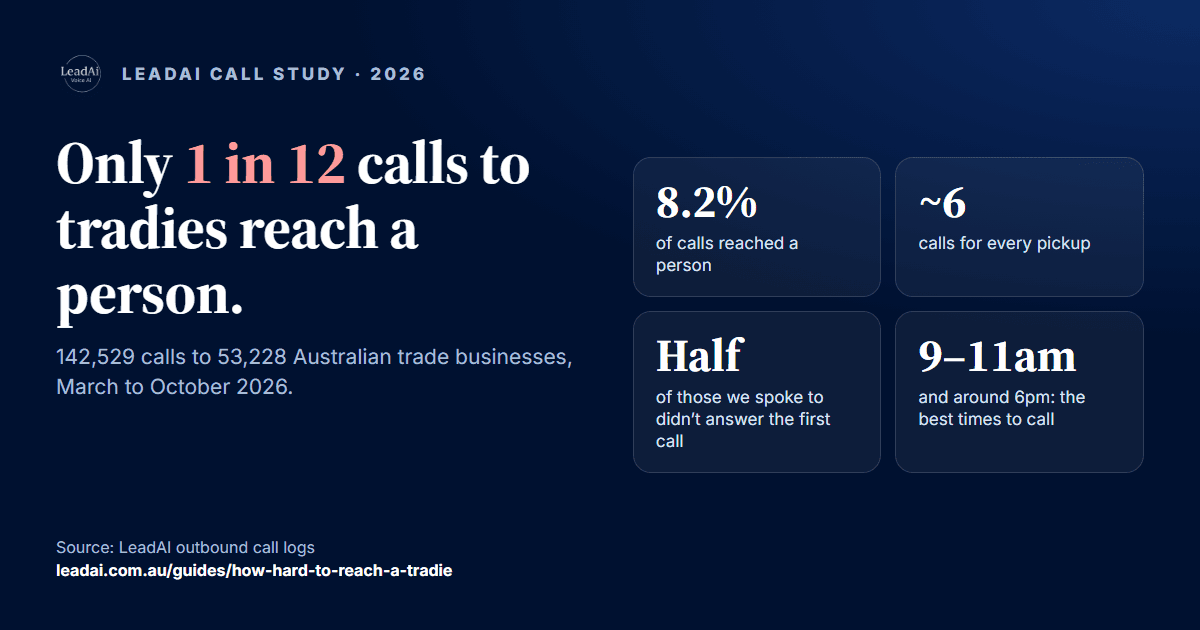
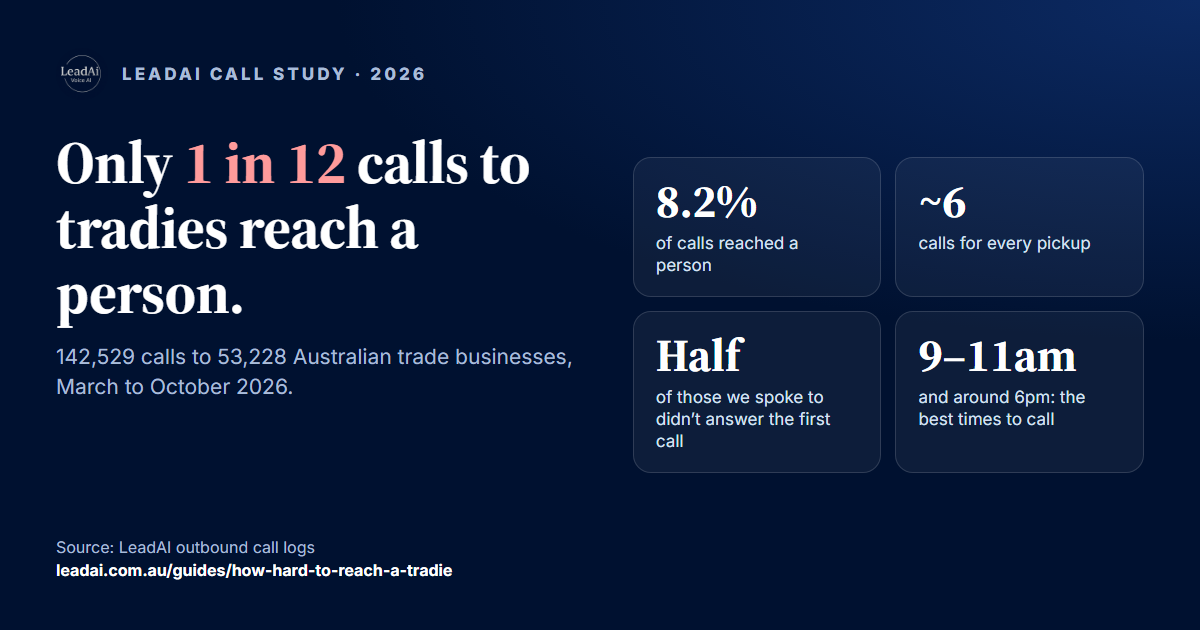
Hard. Across 142,529 calls LeadAI made to 53,228 Australian trade businesses between March and October 2026, only 8.2% reached a person: about 1 in 12. A person answered the first call at fewer than 1 in 10 businesses, and half of the businesses we did speak to only answered on the second call or later. It took about 6 calls for every pickup and about 12 for every call where a person spoke. Early morning and around 6pm were the best times to get through.
The headline numbers
| Measure | Result |
|---|---|
| Outbound calls analysed | 142,529 |
| Trade businesses called (each phone number counted once) | 53,228 |
| Calls where a person spoke | 8.2%, about 1 in 12 |
| Calls picked up by anyone (including instant hang-ups) | 17.3% |
| Businesses where the first call reached a person | 9.7% |
| Businesses never reached by a person (after 2 to 3 calls on average) | 81.0% |
What it means: if you ring a tradie once, you’ll most likely get voicemail. And if your customers ring you while you’re on the tools, the same thing happens to them.
Where the calls actually went
From the detailed sample (77,338 calls to 30,955 businesses, 15 September to 30 October 2026), here’s how every call ended.
| Outcome | Share of calls |
|---|---|
| Never connected (rang out, or the phone network refused the call) | 45.1% |
| Voicemail | 35.6% |
| Picked up and hung up straight away | 8.2% |
| A real conversation with a person | 7.4% |
| Connected, but nobody spoke | 2.0% |
| Wrong number | 1.0% |
| Busy | 0.5% |
| Failed connection | 0.2% |
Only about 1 call in 13 turned into a real conversation. Voicemail alone took more than a third of all calls.
Pickup call by call: why the second and third calls matter
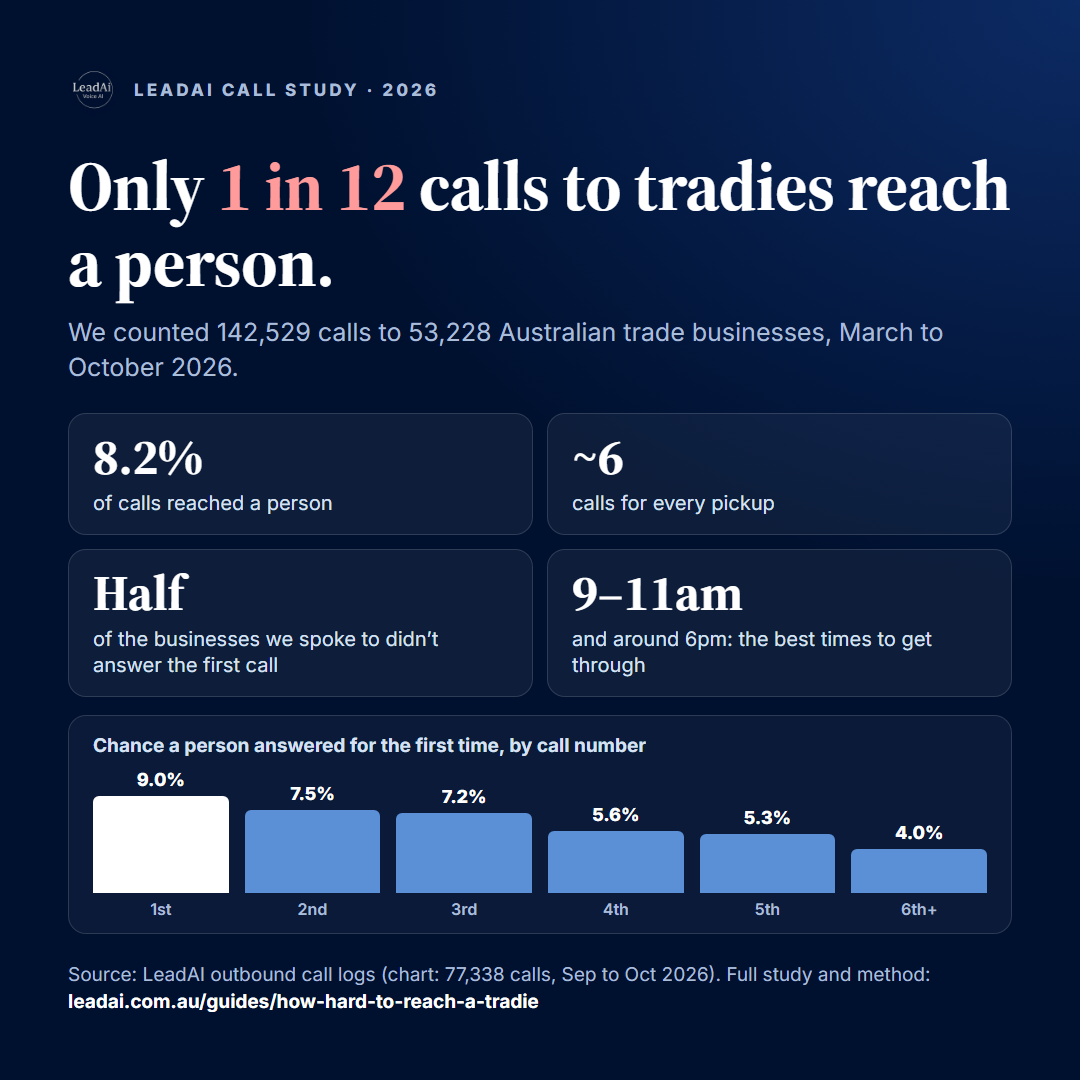
Here’s the chance a business picked up for the first time on each call, among businesses we hadn’t yet reached. The rate drops slowly, so every extra call still finds new people.
- Half of the businesses we eventually spoke to didn’t answer the first call: 50.5% picked up on call 1, 27.2% on call 2 and 15.2% on call 3.
- It took 5.9 calls for every pickup, and 11.9 calls for every call where a person spoke.
- If calling had carried on, about half of all businesses would have picked up by around the 5th call, and 65% by the 8th (an estimate, explained in the method).
- A real conversation is harder: an estimated 30% by the 5th call and 44% by the 10th.
| Call | A person spoke | Anyone picked up |
|---|---|---|
| 1st call | 9.0% | 17.6% |
| 2nd call | 7.5% | 14.8% |
| 3rd call | 7.2% | 14.5% |
| 4th call | 5.6% | 12.3% |
| 5th call | 5.3% | 13.1% |
| 6th call and later | 4.0% | 8.1% |
What it means: one call isn’t follow-up. Stopping after one call writes off half of the people who would have answered.
The best times to get through
Of the calls that connected, these were the hours and days a person was most likely to speak. Sydney time, weekdays only. Treat them as a guide, because which list we were calling also changed through the day.
| When | A person spoke |
|---|---|
| 9am to 10am | 18.7% |
| 10am to 11am | 18.8% |
| 11am to 12pm (the lowest daytime hour) | 12.1% |
| 12pm to 5pm | 14.0% to 16.6% |
| 6pm to 7pm | 18.9% |
| Friday (the best day) | 20.0% |
| Tuesday (the lowest day) | 11.8% |
What it means: tradies are easiest to reach before they get stuck into the day, and again once the tools are down around 6pm. Late morning is the hardest.
What this means for your business
- Your customers hit the same wall. When they ring you on a job, it goes to voicemail, and many will ring the next business rather than wait.
- Call leads back more than once. Half of the people we reached only answered on the second call or later.
- Mix in texts and emails. With a person answering the first call at fewer than 1 in 10 businesses, a text or email between calls keeps you in front of them.
- Ring early or around 6pm. Those were the best hours in our data. Late morning was the worst.
- Keep going until it’s a clear yes or no. Most businesses give up long before the person on the other end does.
How we worked it out (method and limits)
- The calls: every outbound call our AI staff made on two LeadAI accounts, from March to October 2026 (98% of one account’s calls were July to September; the other ran 15 September to 30 October). 142,529 calls to 53,228 phone numbers.
- Who we called: Australian trade businesses that hadn’t asked us to call, from LeadAI’s own numbers. In the detailed sample, nearly all were mobiles, and calls were made on weekdays between 9am and just before 10pm Sydney time.
- How outcomes were sorted: the phone platform records whether a call connected. A post-call classifier labelled each connected call from the transcript as voicemail, a conversation, a wrong number and so on. “A person spoke” means any conversation or wrong number.
- The “never connected” figure includes calls the phone network refused before the phone rang, so it overstates pure ring-outs. The share where a person spoke barely moved when that changed, so it’s our steadiest figure.
- Some calls labelled voicemail were screened by the phone’s own call-screening feature rather than missed.
- Each business is a phone number, so a business with two numbers counts twice. The call-by-call figures only count calls made within the window.
- The “by the 5th call” estimates assume businesses we stopped calling would have behaved like the ones we kept calling (a standard survival estimate).
- No names, numbers or businesses are published. All figures are totals.
Using these figures
You’re welcome to quote any figure on this page in an article, post or presentation. Please name LeadAI as the source and link to this page. For more figures on calls, quotes and getting paid, see our statistics page.
Questions people ask
- How many calls to tradies get answered?
- In LeadAI’s study of 142,529 calls to 53,228 Australian trade businesses from March to October 2026, only 8.2% reached a person, about 1 in 12. Including people who answered and hung up straight away, 17.3% were picked up.
- How many times should you call a lead before giving up?
- More than once. In our data, half of the businesses we eventually spoke to didn’t answer the first call, and it took about 6 calls for every pickup. An estimated half of businesses would have picked up by around the 5th call. Mixing in texts and emails between calls helps.
- What is the best time to call a tradie?
- In our calls, a person was most likely to answer between 9am and 11am and around 6pm to 7pm on weekdays, and least likely in late morning (11am to 12pm). Friday was the best day and Tuesday the lowest.
- Why don’t tradies answer their phones?
- They’re working: on a roof, under a house, driving or with a customer. In our data, more than a third of calls went to voicemail and a person answered the first call at fewer than 1 in 10 businesses.
- Where does this data come from?
- From LeadAI’s own outbound call logs: every call our AI staff made on two accounts between March and October 2026, 142,529 calls in all. The method and its limits are on this page.
Sources
More guides
- Australian trades statistics 2026: calls, quotes, getting paid and AI
The numbers behind running a trade business in 2026: calls, response times, quotes, late payment, office costs and AI use, each with its source.
- What a missed call costs a tradie, and how to stop missing them
What the research says about slow replies, how to work out what your missed calls cost, and four ways to stop missing them.
- How to follow up a quote without being pushy
When to follow up, what to say word for word, and the Spam Act and calling rules every follow-up text, email and call has to meet.
- Receptionist, answering service, VA or AI: what each really costs in Australia in 2026
Award wages, answering service per-call fees, offshore VA rates and AI plans, side by side, with the maths shown.
- AI leads for tradies: finding new leads vs following up the ones you already get
AI lead generation and AI lead follow-up are different jobs. What each does, what it costs, and why the leads you already get are the cheapest ones to win.